

The National HVDC Centre, in collaboration with Scottish Power Energy Networks (SPEN) and National Grid Electricity Transmission (NGET), is supporting the development of the Western Link 2 (WL2) project by performing the conceptual Multi-terminal HVDC (MTDC) network design feasibility studies and associated design reviews.
WL2 is a proposed MTDC scheme designed to reinforce the Great Britain transmission network and enable greater integration of offshore renewable generation. The scheme is envisioned as a three-terminal HVDC system linking Scotland and Wales, with an additional offshore converter station to integrate renewable energy from the Irish Sea.
The proposed design adopts a multi-terminal VSC rigid bipole configuration. The three HVDC cables are interconnected via a DC switching station (DCSS) located in Ayrshire, which enables controlled power flow, fault isolation, and operational flexibility across the multi-terminal system.
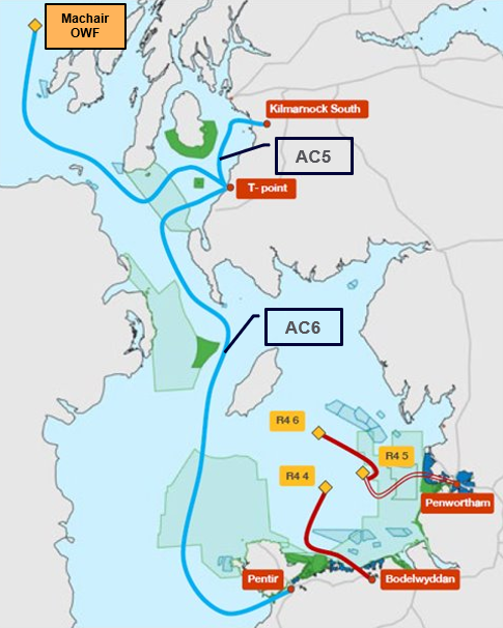
The National HVDC Centre is developing system models using real-time simulation platforms to assess the performance and operability of the WL2 scheme. Dynamic studies are being carried out to evaluate steady-state behaviour, energisation procedures, and system response to disturbances and fault conditions.
These studies also investigate key design considerations such as multi-terminal control interactions, earthing arrangements, and the role of dynamic braking systems under fault scenarios. The results will provide technical insight to support the ongoing design development and ensure robust system integration. In parallel, the National HVDC Centre provides a technical advisory role by reviewing the WL2 feasibility and concept designs submitted by the HVDC suppliers. This includes assessment of converter design, control and protection strategies, and overall system integration aspects.
The WL2 project enables informed decision-making across key stakeholders through this integrated programme of simulation studies and technical advisory services. It supports the development of a resilient, flexible HVDC system capable of accommodating large-scale renewable generation and facilitating its effective integration into the GB network.