

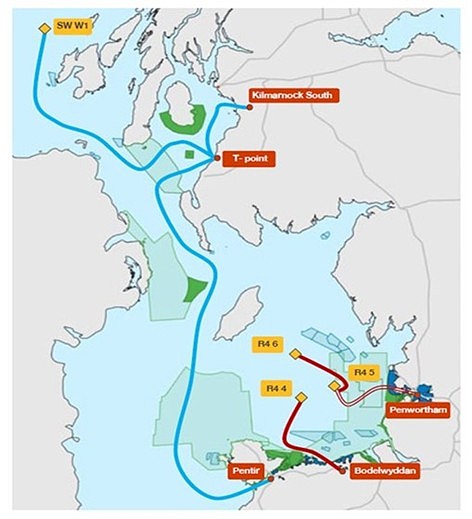
The National HVDC Centre, in collaboration with NESO, is undertaking an initial investigation to assess the impact of the multi-terminal HVDC design on the onshore network. To derive insights from a comprehensive feasibility assessment, this investigation utilises an example design from the proposed multi-purpose HVDC interconnector between Scotland and Wales, which is part of the initial design proposed as part of Holistic Network Design (HND) exercise. The proposed scheme is envisioned as a multi-terminal HVDC system, providing a direct connection between Kilmarnock South and Pentir, and incorporating an offshore converter station to integrate approximately 2 GW of offshore wind capacity from the Irish Sea.
An overview of the multi-terminal HVDC configuration, along with the preliminary technical concept, is presented in the illustrative map given in the figure. This converter station in Scotland will connect to the Kilmarnock South substation, while the corresponding station in Wales will connect to Pentir. The T-point near Ayrshire will not be electrically integrated with the onshore AC network. The proposed design adopts a multi-terminal HVDC Bipole configuration with a metallic return.
The Centre will develop detailed models on the RTDS platform and perform various studies to analyse steady- state performance, energisation procedures, and system response to faults and disturbances. These studies will build on generic models from previous projects, leveraging the Centre’s expertise in multi-terminal HVDC systems. The primary goal is to assess the technical feasibility of operating a multi-terminal Bipole with a metallic cable return. The results will provide NESO with valuable insights into the scheme’s operational performance
Image Source Ref: Beyond 20230 Holistic Network Design (HND)