

Project Aquila is a world-leading initiative aimed at developing a multi-terminal, multi-vendor DC hub to demonstrate interoperability and establish the foundations for future DC grids in Great Britain. The hub, originally named the Peterhead Hub and located at SSEN’s Peterhead site, plays a key role in reducing costs and environmental impacts by minimizing the need for additional onshore converter stations. In 2024, the hub was renamed the Netherton Hub.
Launched in October 2022, the project is structured into three main work packages, as illustrated: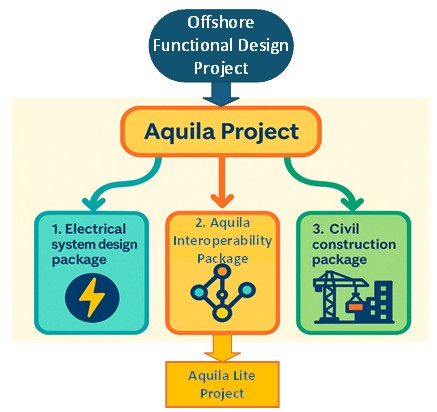
- Electrical System Design Package – Focused on DC hub development and system design.
- Aquila Interoperability Package – Dedicated to interoperability studies for multi-vendor, multi-terminal (MVMT) systems. This package was then succeeded by project “Aquila Lite”
- Civil Construction Package – Concentrated on the construction life cycle and project realization.
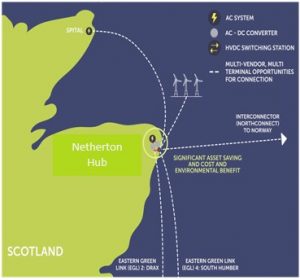 Currently, the Aquila Interoperability Package is ongoing as “Aquila Lite”, while the electrical system design and civil construction packages have been put on hold after the development of functional requirements, system requirements, and station and equipment layouts.
Aquila represents a pathfinder project as approved by the energy minister, BEIS, Ofgem and National Grid ESO in July 2022. A copy of this letter of support may be found here:
ministerial-pathfinders-letter-aquila.pdf
Project Aquila, hosting the GB HVDC Interoperability Expert Working Group, is creating a practical framework of control architecture and test protocol to support a multi-terminal multi-vendor solution for HVDC hubs (with particular focus on the Netherton Hub use case) and apply lessons learned to future HVDC networks in GB.
The working group is attended monthly by representatives of; GE Vernova, Mitsubishi Electric, Hitachi Energy, Siemens Energy, and related transmission and system operators of the GB Power System to review multi-terminal control approaches being adopted and the associated tests and specifications relating to them. During the monthly meetings, technical presentations are delivered to members of the working group, in addition vendors provide updates on their activities as part of these sessions.
As part of the project, The National HVDC Centre is undertaking the “Aquila Interoperability” workstream , which is a £ 2M project over three years in 2022-2024, then from 2024 -2026, with an increase of funding by £ 450k, the HVDC Centre has expanded the workstream with ‘Aquila Lite’.
Each manufacturer is working with HVDC Centre bilaterally to provide IP-protected “black-boxed”, detailed, and real-time models of their Converter Stations to The National HVDC Centre. The project team is then able to run stability testing before incorporating into wider real-time simulations to prove operation in a multi-terminal environment. All testing and demonstration is achieved without opening up internal design of Converters or their control and protection systems.
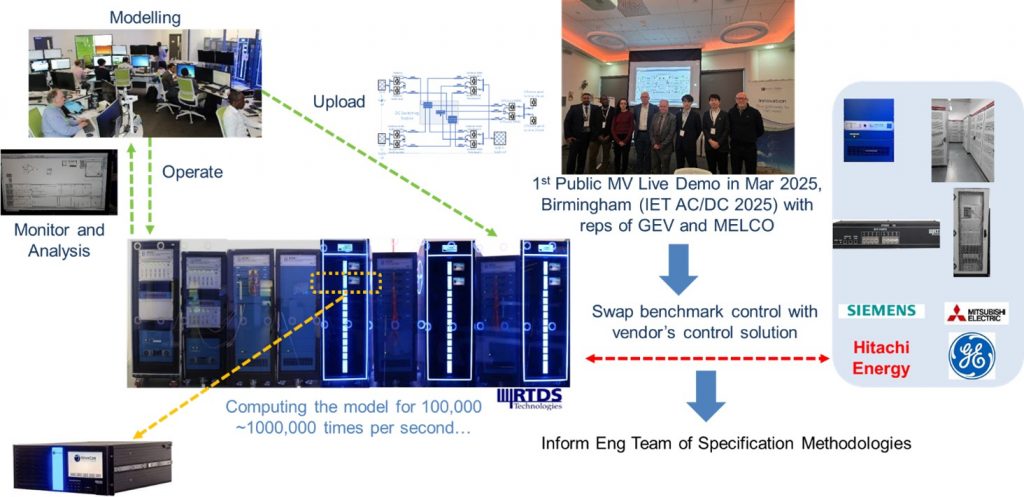
This work follows on from the completion of a project “off-shore functional design” funded by the Department for Business, Energy and Industrial Strategy (currently known as Department for Energy Security and Net Zero) of UK government which has constructed the key components of HVDC systems such as Project Aquila and other HND arrangements. The body of work enables assessments in a vendor agnostic manner, and allows ‘dry runs’ of the vendor tests to be conducted in a deliberate, incremental manner. The test environment includes a number of “world firsts” using new real-time software-in-the-loop technologies such as the RTDS GTSOC, to simulate vendor replica control & protection.
Key Achievements
Some of the key achievements of the Aquila project are shown below.
 |
 |
 |
|---|---|---|
| Scottish Green Energy Awards | Public Demonstration of Interoperability | IET AC/DC Conference 2023 Best Paper Award |
| On 4th December 2025, the Aquila (Lite) project won the award of ‘Best Innovation – New Technology Product’ at the Scottish Green Energy Awards 2025,which are one of the UK’s most prestigious renewable energy awards, attended by over 1,600 industry leaders. This accolade celebrates our pioneering work in delivering vendor‑agnostic HVDC control solutions, a world‑first achievement that sets new standards for interoperability and grid resilience. |
In December 2024, the first successful multi‑vendor, multi‑terminal HVDC interoperability demonstration was achieved using the Aquila methodology, ensuring full protection of each vendor’s intellectual property.
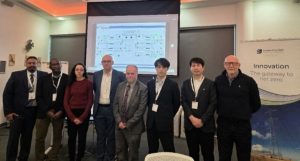
The first public demonstration took place in March 2025 during the IET AC/DC Transmission Conference, as the concluding session of a three‑hour tutorial introducing the Aquila methodologies. |
The National HVDC Centre’s paper, “Towards HVDC Interoperability – Assessing Existence of Equilibrium with Reference to Converter Terminal Behaviour,” received the Best Paper Award at the 2023 IET AC/DC Transmission Conference.
This innovative research introduces a clear, practical methodology for quantifying the operating point of multi‑terminal HVDC systems, helping ensure stable and secure operation across equipment from different manufacturers. |
References, Publications and Patents
To prevent aggressive patenting activities and avoid novelty claims, publications have been made available in public domain and patents have been filed. SSEN-T and the National HVDC Centre are encouraging manufacturers, developers, and owners to learn from and deploy these learnings and methods. The publications have been included in the references in the link below:
Further updates on the project will be provided as soon as they become available.
Project Team
For details on the project team please, click here.