

The SPRINT (Superconducting fault current limiters Potential to limit Reactor Implementation within DC Network Topologies) project is an innovation initiative delivered under the Ofgem Strategic Innovation Fund (SIF), led by SSEN Transmission in collaboration with the National HVDC Centre and SuperGrid Institute.
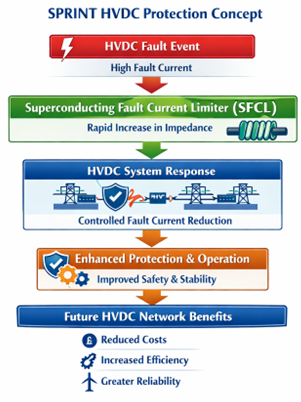
The project focuses on improving the performance, protection, and efficiency of HVDC networks through the application of Superconducting Fault Current Limiters (SFCLs), an emerging technology capable of transforming how direct current faults are managed in future HVDC systems.
The increasing deployment of HVDC systems, particularly for offshore wind integration and multi terminal networks, introduces significant challenges in fault management, system stability, and infrastructure cost. Future multi-terminal HVDC protection approaches rely heavily on a combination of DC circuit breakers and DC reactors, which must operate extremely rapidly to limit fault currents. However, these solutions are associated with:
- High infrastructure cost and complexity
- Large equipment footprint, particularly critical for offshore platforms
- Potential impacts on system stability due to large inductance requirements
The SPRINT project addresses these challenges by investigating alternative fault current limiting technologies that can reduce reliance on conventional solutions while improving overall system performance. The SPRINT project aims to deliver a clear understanding of how SFCL technology can be applied to HVDC networks. The key objectives include:
- Assessing the technical maturity of SFCL technology for HVDC applications
- Evaluating the effectiveness of SFCLs in limiting DC fault currents
- Quantifying potential reductions in system losses and infrastructure requirements
- Identifying optimal deployment strategies for future HVDC networks
- Supporting the development of scalable and cost-effective protection solutions
These objectives support the long-term transition towards more efficient and flexible HVDC architectures.
Superconducting Fault Current Limiters operate based on a unique physical principle. Under normal operating conditions, SFCLs exhibit near zero electrical resistance, resulting in negligible energy losses. During fault conditions, their resistance increases rapidly, introducing impedance into the system and limiting fault current magnitude. This dynamic behaviour enables SFCLs to:
- Reduce the rate of rise and peak magnitude of DC fault currents
- Complement or partially replace conventional DC reactors
- Improve system selectivity and coordination in complex HVDC networks
SPRINT delivers innovation across multiple dimensions of HVDC system design:
- Reduced infrastructure requirements
- Improved system efficiency
- Enhanced protection performance
- Optimised offshore platform design
- Increased network flexibility
These benefits are particularly relevant for future multi terminal and offshore HVDC systems, where cost, space, and performance constraints are critical.
The National HVDC Centre plays a key role in the SPRINT project by providing technical expertise in modelling and system analysis. The Centre contributes to:
- Evaluation of HVDC system performance with SFCL integration
- Assessment of protection strategies and fault behaviour
- Development of technical insights to inform future demonstration phases
The SPRINT project currently is in discovery phase and represents an important step towards next generation HVDC protection solutions. By exploring the application of superconducting fault current limiters, the project provides critical insight into how future HVDC networks can be designed to be more efficient, scalable, and resilient. This work directly supports the development of advanced HVDC technologies required to enable large scale renewable integration and achieve the United Kingdom’s net zero ambitions.